Showing posts with label rtw. Show all posts

Saturday, 24 August 2013

Wake me up

Time flies when you are young. Time flies when you are having fun. Time flies when you have great company. Time waits for no man. Time. I wish I could turn back the time.


I was going through my photographs as I made one last video. Lots of memories came flooding back. I wish there were some mechanisms that would allow me to capture more moments, maybe by blinking my eyes or by snapping my fingers. But both would not have worked because I would not have blinked my eyes, fearing that I would miss a beat and I would probably get severe cramps by snapping my fingers too often.  

Did I regret going on this trip? No. Definitely NO REGRETS.

Would I have done it differently? Yes and no. I would have loved to have done the safari leg with my mum but she never came and would have loved to go to the Grand Canyon or snowboarding with a friend who promised to show me around but it never materialised. Now that I have been to all 7 continents within 1 year, if I do have another go again, I would probably travel the whole duration in 1 continent or 1 country.

Would I revisit any of the destinations I have been? I will gladly visit all of them again. However, given that there is so little time and money and so many more places to go, I am unlikely to revisit any of these places any time soon. 

Next to where I live now was a hotel built in 1892 which got turned into part of the oldest  hospital in Australia and then a backpackers hostel. Every day, the backpackers, with their heavy backpacks and all, remind me how it was like and how I wish that I were still one of them. Where would I go next? I am not sure. I hope to visit the ski fields in Melbourne or the desert in Uluṟu next. Eventually, I would like to reach the North Pole.

To everyone whom I met along the way - Thank You for making this journey an unforgettable one. It would not be the same without You. 


Video
Music: Wake me up by Avicii
Photo and video credits: Thank you all who have taken these precious pictures and videos of and for me.

Till we meet again.
xoxo,
J

Thursday, 7 March 2013

My packing list: To bring or not to bring

Have booklets, Can travel

Almost every single rtw traveller is obsessed with the packing list, and not without reason. This is, after all, your only possessions when you travel for the next X number of months.

Generally, advices from websites are:
1. gather all the things you think you will need, half it and bring twice as much money.
2. bring the items that are not easily replaceable (e.g. specific medication) and if you have travelled before, the comfort items that you must have (e.g. your lucky tshirt). Anything else, you can buy (refer to item 1).

In other words, it does seem that one can travel with only the little booklets and cards and nothing else. Unfortunately it is not the case - we do not own a bank and we are human beings who need their protections (think worst case scenario) and possessions (think electronic gadgets).


What type of items

I started the packing process 2 months before my departure by researching on what are required. I looked at where people have been, their corresponding packing list and their review on the original packing list (on what was added and what was discarded or sent home). These are then matched to the places which I think I would be going. The new items are added to an existing packing list which I started 15 years ago and have been constantly updating since.


What brand of items

Next, I researched on what I had to buy by typing search words such as "how to choose a backpack" and "hyvent vs goretex review". Once I had some idea what to look out for, I go to the brand's website to check on the specifications (e.g. 100% fleece vs down) and the weight. 

Sometimes, the more I checked, the more confused I became. It 'helped' that there were limitations as to what was recommended by users on the internet vs what was available in the shops at home. When I started shopping for the winter wear, it was already February in Singapore. There were no more cheap and good heattech items at Uniqlo and no more long sleeved thermal wear from Columbia. I then had the option to buy online from overseas, take what was best available in shops at home, borrow or not bring the item at all. Belinda offered to buy things in Australia when she went home. Wendy, Belinda and Poh Leng also offered me some of their items.


What I brought

I have listed what I have packed for the rtw trip eventually, which weighed a total of 26kg (19kg check-in and 7kg carry-on). I have listed the brands, and in some cases, the sizes and why I have chosen the items so that we could see how these items measured up during the trip. In no way am I endorsing the brands.

THE Bag
  • Osprey Farpoint 70 (S/M)
  • Osprey rain cover (medium)
  • Tatonka Schutzsack (medium)
  • 1 shoe bag
I did not choose a trolley bag because it would be too difficult to carry a trolley bag up and down stairs in train stations and neighbourhoods where lifts and escalators are not common or where roads are cobbled. Also, as I was going on trekking trips that lasted for more than a few days, a trolley bag will not make sense and I will naturally need a backpack to hold my gear.

I then chose a front loading backpack over a top loading one because I wanted to be able to unzip the bag and view everything I had inside the bag. Front loading bags can also be locked (although it is not of much use if one wants to slash the bag.) The downside to using a front loading backpack is that the zip is more vulnerable. I was worried from time to time when the seams and the zip looked like there were going to burst. Also, front loading backpacks are essentially city backpacks. They do not have as many loops and buckles for hiking gear such as ice axe if you intend to hook them on the outside of the bag while hiking.

The Osprey bag I have chosen is made up of a 52l main backpack with a detachable 15l daypack that can be zipped on the front of the main backpack or clipped on the harness of the main pack for added security. Being able to clip the day pack also means that one only has 2 harnesses and not 4. It also has straps inside and outside the main backpack to hold the bag together (and prevent it from bursting). The bag is really light (1.7kg, with optimal load of less than 18kg). The bag does not fit me perfectly - because I am short, the hip belt does not sit nicely on my hip. I made do with it because there are not many available options from other brands in Singapore (I am not keen on buying bags online because I am not sure of the fit).

The shoe bag held 3 pairs of footwear, socks (stuffed inside the shoes to protect the shoes), some toiletries and 1 book that I could not squeeze into the main backpack.  

The main backpack and the shoe bag are thrown into the Tantonka Schutzsack (a cargo bag) for checking in. I had wanted to buy a pacsafe eXomesh to protect the backpack from being slashed. In the end I decided against it because it is expensive and weighs 1.5kg. I relied on the cargo bag to keep my backpack safe. On days that I went for long hiking trips, the cargo bag was used to hold the items that I left behind at the hotel's concierge.
I think I can fit into my bag


Clothes 
I knew I could not bring my whole wardrobe but neither did I want to bring only 1 change of clothes and do laundry every day. It also did not help that I needed clothes for summer and winter, for sports and the city, for mountains and the beach. The clothes also have to be quick dry and preferably, rain proof. Not easy huh?
  • 3 singlets
  • 1 nice top (for concerts)
  • 1 wool top
  • 1 cardigan
  • 2 Uniqlo heat tech long-sleeved tops
  • 2 The North Face warm base layer (top)
  • 1 jeans (I refuse to go out in cargo pants that can be transformed into shorts)
  • 2 Uniqlo heattech leggings
  • 3 shorts (2 for city and 1 for sports)
  • 1 skirt
  • 1 summer dress
  • 1 Nike cap
  • 1 track suit
  • 1 The North Face Mountain Light Triclimate jacket (Goretex + down 550)
  • 1 The North Face Venture pants
  • 1 Columbia beanie
  • 1 The North Face balaclava
  • 1 The North Face Triclimate Hyvent gloves
  • 1 swimwear and goggles
  • Undergarments
  • 4 footwear (hiking boots, runners, black flats, flip-flops)
  • 6 socks (short one for runners, woolly ones for winter, thermal liners for trekking and winter)
  • 1 Sea to Summit drylite towel (small)
  • 1 of Mum's tiny handkerchief
  • 3 vacuum bags and 3 laundry nets, both from Daiso 
  • 1 bag for city/ school (not carrying daypack in the city as I feel unsafe that the bag is behind me)
  • 1 sunglass
Some travellers advocate using compression sacks while others use packing cubes. I found vacuum bags and laundry nets that cost S$1 - S$2 each (10 times cheaper than compression bags and packing cubes) more cost effective and practical (They are good for organisation, weigh next to nothing and can be flattened or rolled up when not in use).

TNF triclimate jacket only takes up this much space
(as pictured next to a beanie)
Vacuum bags work best by using vacuum cleaners to remove air from the bag and compressing the content (in this case, clothes) at the same time. In the absence of a vacuum cleaner, one can sit on the item, roll the bag and squeeze out the air to compress the content. 

One thing to note however, is how one uses the vacuum bags. Initially, I tried putting all 2kg of winter gear into 1 big vacuum bag. The final result was a slab that could not be 'compromised'. My sister then suggested splitting the items into 2 smaller vacuum bags. Although the total volume of the 2 smaller vacuum bags was the same as that of the 1 big vacuum bag, the smaller vacuum bags could be manoeuvred around the backpack easily in consideration of the final organisation of the contents in the backpack.

As my main backpack is small, after putting in 'structured' items such as the 2 hard slabs of winter clothes, the toiletries and the electronic gadgets, I was unable to squeeze packing cubes (which have fixed shapes) into my bag to keep my clothes organised. Consequently, I used the laundry nets to keep some the clothes together. Laundry nets are lightweight and when I did my laundry, the laundry nets were used to protect my laundry from falling apart easily.
Laundry net

Electronic and other gadgets

  • 1 Apple MacBook Pro 13" laptop [to book flights, check emails etc. Has reasonable speed and a slotted optical drive (as opposed to external optical drive that competes for the same usb slots)]
  • 1 Apple AirPort Express WiFi base station (to turn cable network into WiFi)
  • 1 Western Digital Passport external hard drive (to back up my pictures in case my laptop fails or goes missing)
  • 1 thumb drive (to share files with others)
  • 1 Apple iPod Classic 
  • 1 iPhone, 1 Blackberry smart phones (1 for home number, 1 for local SIM)
  • 1 additional earphone (for just in case I lose the current one I am using)
  • 3 iPhone USB cables and 1 Blackberry USB
  • 1 Canon Ixus 80IS camera, 3 batteries and battery charger
  • 2 travel adaptors
  • 1 kensington lock for the laptop
  • 1 whistle
  • 1 Energizer personal alarm with LED light


Medication/ first-aid kit

  • Elastic bandage (5cm)
  • Lots of plasters, blister plaster, alcohol swaps, cotton pads
  • Benzamycin cream for pimples
  • Hand sanitizer (Dettol)
  • Water purification tablets (Aquatabs)
  • Eye drops (Alcon)
  • Dimenhydrinate (Novomin) for motion sickness
  • Acetazolamide (Diamox) for acute mountain sickness
  • Chlorpheniramine for cold
  • Doxycycline (Doxyline) for malaria
  • 保济丸 for diarrhoea
  • 青龙膏 for everything
  • 如意油 for everything
  • Antihistamines for sneezing and running nose
  • Paracetamol (Panadol) for everything
  • Serratiopeptidase (Danzen) for sore throat
  • Lozenge (Tussils 5)
  • Mometasone Furoate (Elomet) for skin inflammation from eczema, insect bites
  • Surgical spirit (Guardian)
  • Tea tree oil antiseptic (Thursday Plantation)
  • 1 tweezer
  • 1 scissors
  • Safety pins which also doubles up as clothes pegs
  • 1 ear plug
For vaccination, refer my entry on what to prepare before the trip: http://y2whysquared.blogspot.sg/2012/08/preparation-for-rtw-trip.html

Toiletries
  • 1 shampoo
  • 1 facial wash which doubles up as body wash
  • 1 hand cream
  • 1 QV cream and 1 Cetaphil Intensive Moisturising cream
  • 1 Klorane dry shampoo with oat milk (used when I had no access to showers during trekking)
  • 1 No Rinse moisturising body wash for trekking (never used eventually)
  • 1 BioZ natural insect repellent stick for trekking (did not really work for me)
  • 1 toothbrush
  • 1 dental floss
  • 1 toothpaste
  • 1 comb
  • 1 Ole Henricksen truth serum collagen booster, sheer transformation and invigorating night gel (for dry weather and air conditioning)
  • 1 Nivea sun invisible protection transparent spray SPF 50 for trekking
  • 1 nail polish remover
  • 2 packets of wet wipes from Daiso for trekking

Camping gear

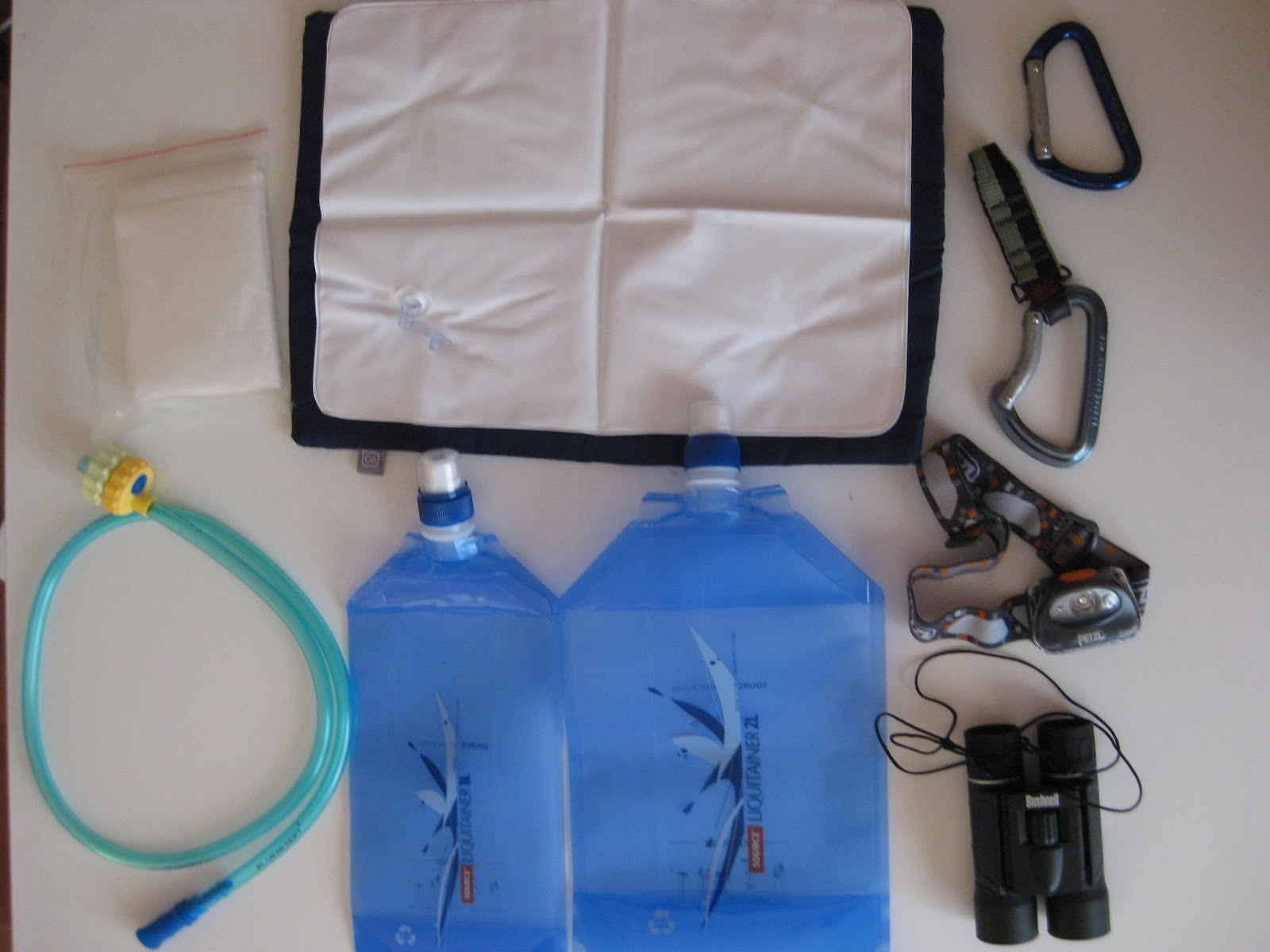
I only brought very basic personal camping gear for this trip and rented bulky and heavy items such as winter sleeping bags as and when I needed them.
  • A 2l and a 1l liquitainer from Source
  • 1 SmarTube 
  • 1 Bushnell 10x25 binoculars for animal spotting during safari, trekking and on boats
  • 2 carabiner 'borrowed' from my brother who rock climbs. To attach items to the outside of backpack (e.g. to dry wet clothes while on the move) or on clothes line
  • 1 Pretzl Tikka Plus 2 headlamp for trekking and reading on trains. I chose this model over the rest because it has both white light and red light (for use during night) and is cheaper than other brands
  • 1 inflatable travel pillow (courtesy of Poh Leng)
  • 1 disposable rain poncho
  • 2 Japanese heat pad


Others
  • 2 thin metal clothes hangers and 5 pegs
  • 1 S-shaped hook to hold my bag when there is no hook in toilets (I am very sure I do not want to set my bag on dirty toilet floors)
  • 1 doorstop for the door (in case the door has no chain lock and I feel unsafe)
  • 1 tiny umbrella for rainy cities
  • 1 small set of cutlery (fork, spoon and chopsticks) to be used if I buy takeaway and cutlery not provided
  • 1 tiny pencil case to hold 1 pen, 1 pen knife, 1 pencil for sketching, 1 magic tape
  • 3 number combination locks (1 for day pack, 1 for backpack, 1 for cargo bag)
  • some plastic bags and some rubber bands
  • Photocopies of important documents (identification card, passport, driving license)
  • Important documents (passport, identification card, driving license, international driving permit, vaccination booklet, credit and bank cards, travel insurance card)

What has broken down

I am happy to say that, except for most medication and the No Rinse moisturising body wash, I have used every single item that I have brought. These items, however, gave way:
  • 1 of the liquitainers - one of the first things to break. The seam of the liquitainer was too closed to the edge and the pressure of the water forced a hole through and leaked water into my bag while I was climbing Mt Kili. (Tip: when buying a liquitainer, check the seam)
  • Smartube. When I was summitting Mt Kili, despite blowing water back into the liquitainer, water somehow froze in the drinking tube. My guide tried to defrost it but accidentally broke it instead.
  • 1 of the clothes hanger
  • A screw of the sunglasses came off twice and I got it fixed for free in London even though I did not buy the sunglasses there (thanks Vision Express!) 
  • Seam of my cargo bag tore and I managed to get it fixed in Galápagos in US$1
  • 1 tshirt tore
  • clasp of cap broke
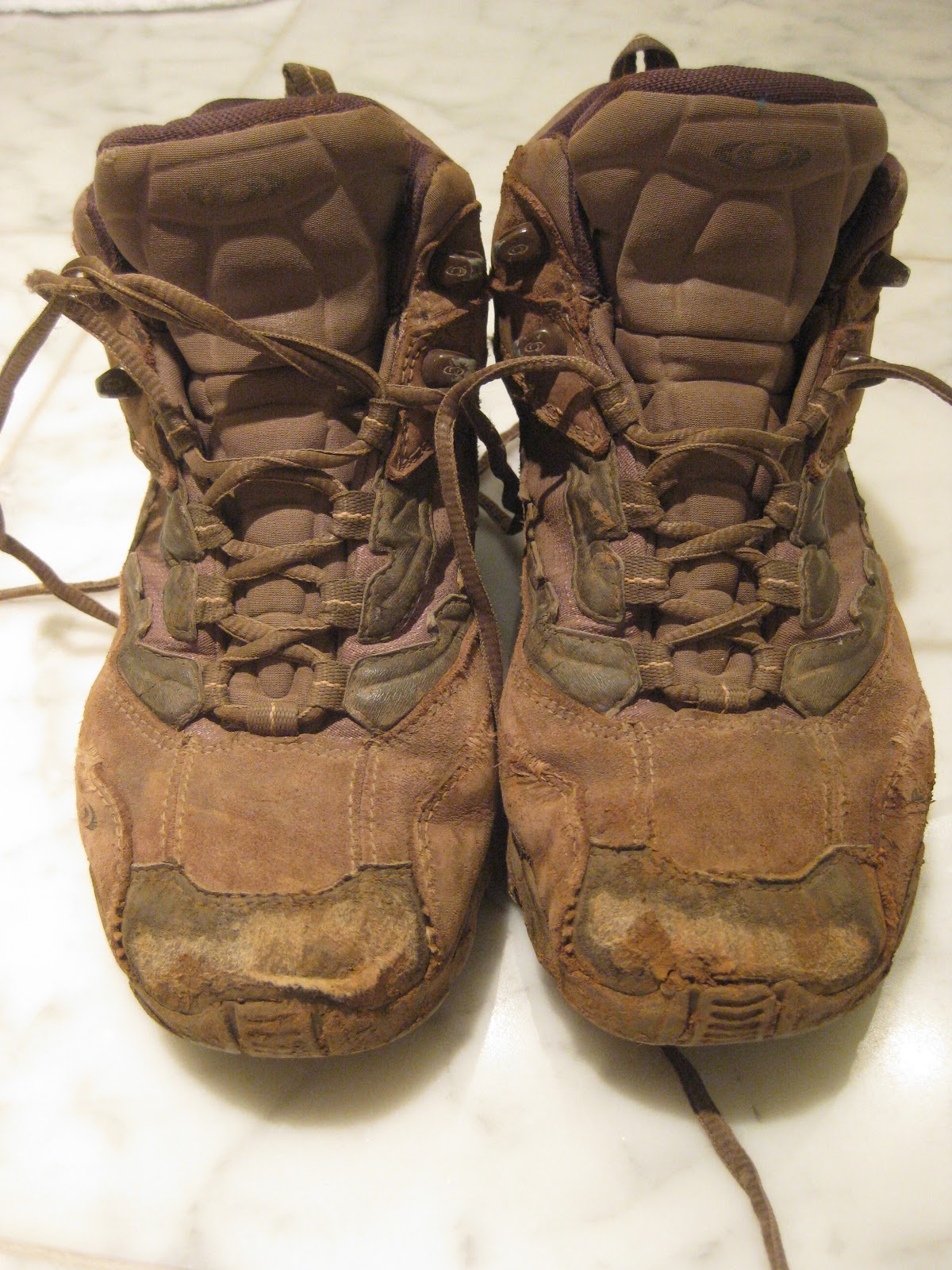
I threw away my trekking shoes on the last day of my trip. The toe caps and heels were very worn out and stunk big time.
My very abused shoes

What I have since bought

One of the sad things of long term travelling was that I had to watch how I spend my money very closely and that essentially meant that I could not go girly shopping. Instead, I could only take pleasure in buying things like toiletries and to replace things that have broken down.
  • Prepaid sim cards in Spain and UK
  • 1 LG prepaid mobile phone in the USA (I could not find prepaid sim cards and the prepaid mobile phone which came with US$30 credit only cost US$45 from Kmart)
  • 1 nail strenghtener for my nails (because they can break or chip easily while traveling) and to mend holes in stockings and bags
  • 1 silk sleeping bag liner which is light and super compact. 1 costs S$250 in Singapore and I bought 1 for less than half this price in France
  • 1 Mammut Goretex trekking pants for trekking on glacier on Haute Route
  • 1 Mammut Goretex gaiter
  • 1 pair of Leki thermolite trekking poles
  • 1 sleeping bag and 1 inflatable mattress in Kenya because they could not be rented cheaply for my overland camping trip. I mailed them home after the overland trip because they were really really too expensive to be donated.
  • 1 2l Source water bladder for trekking. This one lasted for the rest of the trip and is easy to clean and fill up.
  • 1 sunglasses
  • 2 tshirts
  • 2 caps because 1 broke and 1 was lost
  • 1 Johnson & Johnson Sundown aqua, UVA, UVB SPF60 sun screen for snorkelling. The most expensive sun screen that I had ever paid for in my whole life and was purchased in Galápagos.
  • more socks
  • more wet wipes and toiletries
  • more medication to fix my huge blisters and infections: Compeed blister plasters, Dermaplus hydro plaster, Dermaplast Telfa Kompressen (5x7.5cm), 3M Medipore H Klebevlies (5x5cm), Ibonurofen (painkiller). I needed them when I did not have them and did not need them after I have bought them. Bugger!

What I would have also brought

I think a backpacker's best friend is probably the duct tape. I have seen duct tape being used on torn down jacket, torn tents, backpacks etc. The guys used duct tape to hold my rain cover to my bag.
I think I looked like a tortoise
Kirk used it to tape his shoes when they failed him:
You don't have to bring a whole roll of duct tape (although in the case of Kirk, he had to keep replacing the worn out tape because he was trekking). Just tape some tape on a pen or pencil and you would have had yourself insured.


Saturday, 2 March 2013

Home


Transition back

Like me, my friends at work are acid-tongued. We do not mince our words. When I went back to work 2 hours after I had landed in my favourite airport, some of them walked by without acknowledging my presence (thinking it is some newbie at work) while others smiled and/or said a polite 'hi' before they had a double take and shouted:

"HI! IT'S YOU! I THOUGHT YOU LOOK FAMILIAR! YOU ARE BACK!!! WHEN DID YOU GET BACK???".

Pause.

"You look rejuventated"/ "you look younger".

Then the moment of truth:

"You have put on weight."
"You are dark."
"You have pimples!!!!!!" 
"You have so many ugly mosquito bite marks."
"You have thunder thighs."
"Why didn't you take 3 weeks to rest and improve your looks before you come back to work?" (Touché. Somebody. Just Kill Me. Please.)

The only thing that is acceptable is my thicker and longer hair (which I could not afford to cut along the way).

One of the security officers at my office building told me,"You are very sunburnt". 

My mum also offered,"Your bum is too perky" (which translates into "you have a big fat butt").

Faint. Trust them to let me know that I need a weight loss programme, facials, skin whitening and scar lightening treatments, acid peels and cosmetic surgeries. Add these to the massages I now need because I suffer post-traumatic stress from the blows. I think these 'remedials' would be more costly than my whole trip put together. Definitely not for the faint-hearted. Hahahaha!

Going home


I had applied for a 2 month extension of my sabbatical leave but it was not approved. I had to make a decision - go back to work or continue with my travels. The fateful decision to go home was made within 4 days and was back home 5 days later.

Some 2 months before going home, I was having a rather serious bout of depression. I was alright when surrounded by people I knew. When I was alone, sometimes I would stare into blank space and my tears would flow. Everything was but a dream, a really good dream mostly. I felt a desperate need to grasp every nano moment in my hand. On other days, I would draw the curtains, lay in bed, ignored messages that come through my phone and not eat for the whole day. There were a lot of things I would like to do but have not done so (such as visiting my family in Auckland and friends in Australia and resolving my residency visa issue in Australia) and a confirmed cruise to Antarctica prevented me from moving these plans forward. I was just not ready to go home. It felt like chapters of my life have ended with the doors firmly closed and I could not, just simply could not, find the beginning of the new ones.

In the end, it was a head over heart decision and more than anything, a responsibility issue. At work, I had set the precedence of going away for such a long period. I decided to go back in case I become the negative example (of one going on long leave and not returning subsequently) and jeopardise the chances of the next person who wants to go on extended no pay leave.
Water shrine (2010) by Hiroshi Senju
Once I decided to go home, I discussed this with JP (whom I met in Lima airport) on how he coped. He had previously travelled on a long term basis, gone home and is currently on the road again. He said he threw himself into his nursing job and that distracted him when he first went home. I began to research online how others deal with returning home after travelling for extended periods.  The 2 major problems faced were reverse culture shock (how everything you grew up with and used to seem familiar, but when you return, everything is different; how you have to return to the same life, same family and friends when you have changed) and wanderlust. 

I had suffered from a severe bout of reverse culture shock when I first moved back from Sydney to Singapore 6 years ago so I thought I would be able to deal with it again by reminding myself about all the good things at home (I have my support system close to me, I don't have to speak in perfect English and everyone will still understand what I am mumbling about, I know where to find some of my comfort food ie if the shop has not moved, I generally know how to travel from place to place without getting lost or if I do get lost, taxis are safe, relatively cheap and easy to find). 


As for wanderlust, many people said, "9 months had been a long time. You have played for long enough." Unfortunately for most travellers, not only does a rtw trip not cure one from wanderlust, it adds fuel to the fire.  While I was (and still am) totally aware that I have been blessed and was very fortunate to be able to live many people's dreams, I had to give a lot of countries, destinations a miss because I did not have enough time. It also was not just play. I learned a lot about people, geology, geography, animals etc which are absolutely useless at work but make a lot of sense given the grand scheme of things. Sure I could watch documentaries on the same but probably retain 10% of the content. I wanted to enthusiastically share with someone - do you that the Andes mountains that span through 7 countries in South America are of the same mountain range as the Rockies in Central and North America?  Do you know that humpback whales are toothless and sieve tons of krills with their baleens and that they are making a comeback in numbers? Do you know that when you look at the mountains, the hills are not green but in different shades of steel-blue-grey? Do you know... but does it really matter? Why would it matter at all?

Back home, I settled down better than I thought I would. It was year end audit and very busy at work. I clocked the necessary hours and went home brain dead. At home, I had my mum, my tv programmes and writing of my blog to keep my occupied. I allowed myself to wallow in sadness every once in a while. I rationalised that there were so many Asia Pacific countries at my doorstep waiting for me to explore, told myself to snap out of it and move on by planning for my next trip. 
~ Morrie Schwartz


Thursday, 28 February 2013

9 months on

My default world clock
I cannot believe that I have been travelling for 9 months. It has been a blessing to be travelling, and especially more so in the most recent 3 months, when I went to far flung corners of the world. I learnt a lot of new things but also discovered a lot of similarities between countries - like how, outside Asia, there are Africans and South Americans who have rice as their staple, that it is impolite to refuse a mate (a tea, pronounced as "mah-teh") if someone in Chile offers to share a cup and a straw with you.

During my travel, time and days lost their relevance unless I had to be somewhere. Time was a measurement relative to when the sun rose/set or when I was hungry. Otherwise, time came to a standstill while waiting (for someone to contact me, for a transport, for the food to arrive) or sped by when I was having fun. I checked the world clock only when I needed to find someone in another part of the world. I lost track of the days since every day felt like a Saturday. The days of the week only mattered if, for example, a supermarket did not open on Sundays or a museum closed on Tuesdays.

After spending long periods in the jungle, hills and Antarctica in the last 3 months, I found myself trying to catch up with my blog entries. At the same time, I wondered who had been reading my blog as promised and who were the readers from Barbados/ Columbia/Costa Rica/ Cyprus/ Estonia/ Finland/ Guadeloupe/ Latvia/ Moldova/ Mongolia/ Philippines/ Romania/ South Africa/ Ukraine/ Zimbabwe... My top 5 readers were from Singapore, US, Spain, Russia and UK. I knew who could possibly be from Singapore, US, Spain and UK but who were from Russia? Were they faithful readers or people who were randomly googling and researching on something?

Sometimes I thought of people whom I have met along the way and wondered what they were doing and if we would become friends in real life under other circumstances. I was discussing with someone, what the definition of "friend" is. We concluded a friend is "someone you would genuinely cross the road for" - if you see someone from across the road and cross the road just to say 'Hi", the person is your friend. For the longest time, I   was lazy and had not been crossing the road for anyone. Gone also, were the days when I was the organiser for gatherings and parties. I had not reached out simply because I did not need rejections, excuses and what-nots. I did, however, make some effort during this rtw trip and kept in touch with 3 people during the whole 9 months. I very much wanted to hear from more people but seldom initiated contact from my end. Everyone had gone back to their real lives and moved on while mine remained stagnant. I have always thought that since they had my contact details, those who really wanted to, would keep in contact. I really should try harder but last thing I want is to appear needy.

Speaking of "in need", there was 1 thing that never changed over the 9 months - every time I arrived at a new place, I wished that there was a familiar face waiting for me, to give me a big hug and assure me that I had made it safe and sound. Not another worry if I had everything under control. Not navigating through the public transport system and wondering if I had missed the stop. Not negotiating with the taxi driver or fending off the 15 men who were asking me to board their cab with "no, gracias, no" or "muy pesado" if they tried to carry my bag. Not fretting if the driver would truly bring me to my destination.

Despite the many horror stories I heard before and during my trip, I had never came close to any real danger. The closest "danger" I had been was accidentally staying in the hostel where someone I knew just got burgled. Lela, who was on my Galapagos boat, told us how she stayed in Hostel M in Quito, Ecuador, went out for dinner and came back to find her snorkeling gear, clothes, camera, passport and money stolen. When I reached my hostel in Quito, it was 6pm and getting dark. The receptionist told me that a guest has fallen sick, extended her stay, the hostel was consequently fully occupied and if I could be so kind as to stay in another hostel run by the family "next door". "Next door" turned out to be in another block, 1 street away and to my horror, Hostel M. As I had nowhere to go, I agreed to stay for the night only, thinking I could use the internet, find a hotel and move out immediately. I was down on my luck and could not find anything available online, not even a room in a 5-star hotel (what were the odds?!?)! I went to ask for a map so that I could go out for dinner and the receptionist told me the area was not safe and to leave my passport and valuables in her safe. That really freaked me out and I decided to barricade myself in my room to defend myself and my properties and had potato chips for dinner instead. That night, my sister happened to post on Facebook that mum had warmed up her dinner when she returned late. It was the only time I missed home. 
Over time, I did, however, found a strategy to overcome an obstacle I initially had. I have always been a crybaby. Read a book - tears flow. Listen to a song - tears flow. Watch a movie - tears flow. Take a roller coaster ride - cry. Sad - cry. Angry - cry. Happy - cry. One can only imagine how I could easily cry my eyes out when bidding farewell. The trick to not embarrassing myself in front of my friends, I discovered, is to do something stupid. Lost something important before departure and wasted my energy looking for it. Went for last minute shopping and returned late so I had no time to say thank yous and goodbyes. By the time I got to my transport, I would be so tensed and exhausted that I would fall asleep before my transport take off and would have no time to look out of the window and shed a tear. I just had to make sure I woke up just before the champers, umeshu or ice cream were served on board.
Cheers!


Sunday, 6 January 2013

6 months on


I reached my 6-month milestone while at sea in Galápagos. I felt very fortunate to be travelling in good health, safe and sound and without losing most of my possession although I carelessly threw away one of my earrings the day before, thinking it was part of the biscuit crumbs in the pocket of bag (I have removed my earrings and left them in the pocket in case I lost them while snorkelling). By the time I remembered, the very hardworking staff on the boat had already emptied the rubbish bin in my room. Oh well, my own stupid mistake. 


During my travels, I had met many people from very different work background - pilots, nurse/paramedic, teacher, science researchers, retirees (not all of them are old), lawyers, au pair... Many of whom are working just so that they could travel. Some take up contract jobs overseas. Some work very hard in relatively harsh conditions (and presumably for better pay) for 6 months (say, in the mine) and then travel for 6 months.

There were a lot of small talks. The most commonly asked questions have been: 
- What is your name? 
- Where are you from? Where is Singapore? What is the population? What is the highest mountain in Singapore? What is the national animal/bird/flower of Singapore? Which part of Sydney do you live in? 
- How long does it take to fly here from Singapore? (This question would then lead the other party to find out that I had not flown from Singapore.)
- How long have you been travelling? Where did you go? What is your favourite destination so far? Where are you going next? Are you travelling alone? Will you be meeting up with family/ friends to travel together? 
- What is your profession? 

Then the discussion topics would become more personal: 
- How many brothers and sisters do you have? 
- Do you live with your parents? 
- Are you married? 
- Have you got a boyfriend? Why not? Why??? (erm, what answer were you expecting for this question? Seriously!) 
- How old are you? (Most people actually thought that I am 26 years old. Phwahahahahaha!!!!! It always made my day and I never, for once, thought they were just being polite.)

Through the small talks, I learnt more from people from other countries - their lives, food, language, culture... Some further confirmed stereotypes but mostly, it affirmed that if people communicate, some conflicts/wars can be averted.


On the negative front, I had to deal with 2 news of deaths from a distance. Both knew me since I was a baby. It was difficult but we coped somehow.


Wednesday, 15 August 2012

Preparation for rtw trip


These are some of the things I did to prepare for my rtw trip. They are listed in no particular order and will differ from person to person, depending on the destination. When preparing for your trip, do take note of the time frame required for some of the activities (such as getting a passport or getting vaccinations) and schedule accordingly.

Prepare a will

I had wanted to do this some 5 years ago and the rtw trip prompted me to act. In the event something happens to me, I know I have things covered. I went to my friend, Elaine (http://braddellbrothers.com/) to get my will sorted out. 

To get started, one will need:
- a list of assets (the teddy bear will probably fall under the "miscellaneous" category)
- to identify where the assets are (if outside the country) 

Matters to consider would include:
- who will inherit assets
- laws of the respective countries
- 1 will or multiple wills (to say, carve out the assets in the different countries so that the wills can be executed at the same time)
- who to execute the will (thanks - YY and MH!)
[Your lawyer should know what to do. If not, engage Elaine!]

I was quite open about it but my mum was not too receptive. 

Get vaccinations

I went to the Travellers' Health and Vaccination Centre at Tan Tock Seng Hospital to get advice on vaccinations for my travel. I had a consultation with Sister Soh who went through my itinerary, activities and old vaccination records and advised on the corresponding vaccinations and drugs I need. Then an appointment was made with Dr Rowe for prescription drugs. Based on the description of my trip, I was prescribed vaccinations and medication for yellow fever, tetanus, diphtheria, pertussis, polio, influenza, rabies, Japanese encephalitis, meningococcal, cholera, typhim, altitude sickness and malaria.

The vaccinations were scheduled over a few weeks. Some diseases require a series of jabs (eg rabies) while other vaccinations have a short validity period and are scheduled for nearer to departure date. The nurses were very professional with the jabs and thankfully, I did not pass out. 14 jabs and oral medications later, I am more than S$1,000 poorer. 

Check validity date of passport and visa requirements

Check that least 6 months of validity from your intended date of return i.e. if you intend to return 1 year later, check that your passport does not expire within the next 1.5 years.

I also checked if I need visas to gain entry into countries with my Singapore passport in case I need to apply for the visa before I leave Singapore. Singapore's Ministry of Foreign Affairs (MFA) has a section which can be used as guide on this matter:

I must say we have the BEST passport in the world. Visas are not required for most countries (even when it is required of a British or an American). Thanks MFA, or whichever department that sealed the deals!

Register with the Ministry of Foreign Affairs

I also noted down MFA's contact numbers in my phone and e-registered with MFA when I confirmed my first destination.

One enters his personal particulars, some details on the destinations and the person(s) to contact in Singapore in case of emergency. The registration is done online before departure or whilst overseas. With this, alerts (such as natural disasters and civil unrests) can be sent via email or text message to the person or group who is travelling. 
Registration can be done for 1 person or 1 group
The website also states that MFA will also use the same information to contact the person or group should there be an emergency. 

The same site also has a link to overseas Singapore Missions and foreign Missions accredited to Singapore in case one needs direct assistance when outside Singapore.
Notification received upon registration online 
Australia has a similar Smartraveller programme while the USA has a Smart Traveler Enrollment Program.


Read travel advisories

I read travel advisories from Singapore and Australia (I like it how Australia's site is organised by country) on a regular basis and that of the USA just for fun.

http://www.mfa.gov.sg/content/mfa/consular_information/for_singapore_citizens/travel_notices.html


http://www.smartraveller.gov.au/zw-cgi/view/Advice/Index


USA site: http://travel.state.gov/travel/cis_pa_tw/tw/tw_1764.html


Read local news.


Buy a comprehensive travel insurance policy

I already had an annual worldwide comprehensive travel insurance policy with NTUC Income. When checking if this policy covers the trekking trip to Mt Kilimanjaro, I found that the 'annual' coverage ends after I have travelled cumulatively for 90 days, and not for 365 days, as the word 'annual' might have implied. It says:

"The cover automatically ceases after 90 days or on whichever of the following that occurs first: 
- the expiry of the Period of Insurance specified in the policy.
- your return to your place of residence in Singapore. - 3 hours after arrival in Singapore."

In the case of Chatis Insurance, "Annual Multi-Trip means multi trips over the annual period specified in the policy schedule where each trip shall not exceed 90 consecutive days from the date of departure to the date of return to Singapore." 

This means that I have to get a new policy earlier than expected and it has to take into account of the trips I did before the rtw trip.

Worldwide travel insurance policies do have some country exclusions. This is stated clearly on the policy. For example, in my case, travel to Iran is not covered. 

I guess, with any contracts, look at the fine prints.

Obtain an international driving permit

I got mine from Automobile Association of Singapore. This allows me to drive in countries from Afghanistan to Zimbabwe, which are part of a 1949 convention.

The application is very simple and costs S$22 for 1 year. Simply complete a form and submit in person or by mail. Alternatively, if one has his photograph and other documents in jpeg or gif format (of file size less than 100kb), one can also apply for one online:

Prepare backups

Things to back up include:
- credit card
- atm card from different banks
- phone number (of contacts for travel insurance, ISOS, all banks, mobile service provider, emergency contacts, MFA)

I also took photocopy and pictures of my:
- passport 
- driving licence 
- identity card 
I have a photocopy at home, one in my bag and also scan versions to 2 different email accounts of mine and also to my sister.

Check the weather and events

The weather affects when you are going where and the all important, what to bring. For me, after deciding on Antarctica, there is no way I can avoid winter (and winter clothes), so I just check to avoid main tourist seasons and rainy weather.

If you have only 1 winter destination and if transport allows, you may want to consider doing that destination first and then mailing home the winter clothes.

As for events, if one is not travelling for a major event specifically (eg to participate in the Olympics or watch the World Cup), it would make sense to avoid the destination because prices will be up, security will be tight and it will be crowded.

Consult friends and check forums and reviews

I first enlisted my friends' help. San got me linked up with Mel who advised about her Africa trip. Mr Chan WK told his consultant Muze about me and he gave me names of Hellen and Peter in Tanzania. Ida gave me Claudia's contact in South Africa in case I need emergency help.

I posted a draft itinerary under the "Gap Year & Round the World Travel" section in Thorn Tree Travel Forum, explained what I want to achieve and do and asked for critiques. I received some suggestions to move some countries around (which is partly why I went to Spain in May instead July). 

For forums and reviews, there are a few things to note:
1. Participants in forums do appreciate some homework being done before questions are asked. For example, as opposed to asking "I am going to Spain, what should I do?", one could perhaps read some travel guides, come up with a plan and ask "I am going to Spain in May, and intend to go to Barcelona for 5 days and intend to cover X number of things. Is this too much of a rush?"

2. Counter check responses from forums and reviews. Sometimes, other participants will kindly pointed out that some reviews are fake ones written by employees of a company. Otherwise, one can look at the number of reviews and what type of reviews written by the person in question and try form a judgement if the review is real.

Compare prices at different sites

The marvellous thing with internet is that one can reach out to different countries without making expensive telephone calls or having to wait to arrive at a country to make bookings through its tourism office.

There are websites that compare prices in different reservation sources and give you list to run down so that you do not have to search the different websites one by one. For example, from http://www.wego.com, one can find out what a room at Hotel X costs at one glance and book from the website that offers the best rate:


There are also alternatives to hotel stay (especially for people who prefer a home with internet, washing machine and kitchen). Roomorama (https://roomorama.com/) and Airbnb (http://www.airbnb.com/) are now popular websites where owners rent their flats or spare rooms to travellers on short term basis. The owners get extra income while travellers have a home away from home to stay. Again, owners do list their properties on more than 1 websites and prices may not be the same. Consequently, it makes sense to search more than 1 website for the price of the same property to get the best deal (owners normally use the same pictures and similar descriptions - it will be quite easy to tell if it is the same property).

When comparing prices, one may also want to take into consideration that some hotel booking websites like http://www.agoda.com also have points systems where bookings through the website and writing hotel reviews subsequent to the stay would entitle one to points that can be used to offset payment for further bookings (much like airline frequent flyer points). 

Finally, when looking for air tickets, I noticed that the same company based in different countries may offer very different options. For example, when I was looking for air tickets from Spain to Tanzania on expedia.com, expedia.com.sg and expedia.co.uk, I found that there are substantial differences in routes, timing and prices (not due to exchange rates differences). It therefore pays to not rely on just 1 site.