Saturday, 9 June 2012

Ordesa-Monte Perdido National Park: Sestrales Alto

You cannot imagine how difficult it was to write this entry (and I imagine, the next few). Raquel, the walking encyclopaedia, taught me so much about history, geography, flora and fauna in English, Spanish and Latin that I fear I would write something really slipslop and do her injustice. She is an excellent teacher and I am a lousy pupil.


Well, 丑媳妇总要见公婆。Here goes my most sincere attempt:

THE day has arrived - to go to Sestrales Alto in Parque Nacional de Ordesa y Monte Perdido (Ordesa and Monte Perdido National Park). I had not slept well (too worried that I will oversleep and that Javier will forget my food). My tummy was bloated. I had dressed too warmly and had to run back to my room to change into tshirt and shorts. I was nervous.

It was, however, a scenic drive to the national park. We passed by picturesque villages (including Bestué), snow-peaked mountains, glaciers and rivers. Along the way, Raquel shared information and stories about them.

We arrived at Collado Plana Canal (1700m) and the target was Sestrales Alto (2101m).

Before we started, Raquel briefed me on the number to call (112) should there be an emergency and where her mobile phone and car keys were kept in case I need to get help. Javier had packed too much food for me. He probably thought I was undernourished or that I was really going for an idyllic picnic. He prepared 2 huge bocadillos (1 cheese and tomato and 1 egg), an orange, a snack and 1 bottle of water. Raquel said to take only what I need.

I had trekking poles, water and food, binoculars, sun block and warm clothes for just in case. Raquel pointed to where we were heading (we could already see the destination from the carpark). It did not look too difficult – just up and down 3 peaks. Off we went. We did not walk too far before we were greeted by falcons gliding in the sky. 
King in the sky
The dirt track that leads to Collado Plana Canal and the vulture in flight 
Along the way, we heard some squeaks. I thought they were birds. Raquel said they were marmotas alpina (English: alphine marmot, Scientific: marmota marmota). 

Can you tell that these 2 flowers are from the same family?
We ascended slowly. Along the way, we examined the different flora (what is edible, which has medicinal values, what is poisonous) and looked out for fauna. Raquel may not know all names in English but she certainly knew most names in both Spanish and Latin (and sometimes, I could guess the English names from the Spanish/ Latin names). Latin??? She said it is her interest. She was a chemist by training and worked in the pharmaceutical field. Her first love is the mountains and decided to make the switch 6 years ago. She said, as part of the accreditation for mountain guides, one would need to know some basics on flora and fauna. Obviously, she had read up much more. I told Raquel she is just like my mum. When I go for walks with my mum, we would look at the plants and she would tell me the same (well, not the latin names, but what can be eaten and what is medicine).


It was not exactly easy to spot or identify the fauna - they were either in very swift motion or motionless and camouflaged. (Raquel would identify expertly and I would be thinking, "Huh? How could you tell?") Sometimes, the predator in flight would cast a shadow on the ground and prompted us to look up. Can you imagine how amazing it was?

Can you see the bird sunbathing?

Raquel told me how the vast majority of the area (15,608 hectares) was only recently made a national park in 1982. (Only a small part of it was made a national park in 1918. In 1997, it was made a UNESCO World Heritage.) Prior to that, agriculture was allowed. The farmers would burn down trees and the farmed animals would eat away the grass. Consequently some of the hills are bare and we could still see steps in the hills nearby. Till this day, private hunting in the national park is still permitted in some areas (we passed by the signage that indicated the end of the area). 
Stepped slopes, a result of agriculture
Unsurprisingly, the route to Sestrale Altro was covered by only grass, rocks and thistle bushes. 
Thistles
Thistle bushes


We met 2 French who came from the French side of the Pyrenees


The weather was great. It was not too hot in the third week of May but the sun was very strong (no trees = n respite). Raquel said she was surprised I had asked to go to the Sestrales as not too many people know about it. Indeed we saw 5 souls only.


Very soon, we reached our second mini-peak and had both Sestrales Alto and Sestrales Bajo in sight.
Sestrale Alto in the foreground
When we reached Sestrales Alto, I did not lie on my belly on the table-top peak to check out what was below (how scary would that be?). We had lunch on Sestrales Alto, right in front of the Valle de Añisclo:
The view did not disappoint right?
As we had lunch, Raquel described how the river had run through the valley millions of years ago to give its form. We could see the lush trees in the valley against the cold limestones and sandstones that rose above. In the background, there were snow-capped peaks.
Tomato and cheese bocadillo for lunch. Thanks Javier!
A peek through the binoculars
Then Raquel brought out her books(!!!) and maps to reinforce what we saw and where we were. (No wonder she had a bigger bag than mine.)


It was also a lucky day for Raquel too as she saw a ladybird for the first time. It was orange and had a black head and white spots (instead of the usual 7-spot ladybird with red wings with black spots).


The learning did not stop at the end of the walk. At the carpark, we saw big stones with seashell-like attachments on its surface, a proof that it was of sea origin:
As we drove out, we also saw the carnivorous grasilla o atrapamoscas (Eng: long-leaved butterworts or flycatchers, Sci: pinguicula longifolia). Raquel touched the leaf with her finger, put her thumb on the finger and separated her thumb and finger to show me how sticky the mucilage was. (I would have thought that it was an ordinary orchid). [The plant grows in nitrogen poor soil and tops up its nutrients with small insects that it traps on its leaves. The enzymes that line the leaves digest the prey caught within 72 hours.]
Insects stuck on the leaves
Was I impressed!
A satisfied customer - MOI!


Wednesday, 6 June 2012

My first day in Escalona

Escalona

Province: Huesca (of Aragon, Spain)
Population: 220
Altitude: 610m
(Source: Ayuntamiento de Huesca)

Quick recap 

I was in Escalona because the helpful lady at Huesca's Tourism Office suggested that the adventure companies based in Escalona would be a better bet to fetch me to hiking. I had met Jon, the only English speaking taxi driver in Aínsa and he has sent me to Escalona.

Juanjo and Raquel

The lady at Huesca's Tourism Office had given me a list of 4 names and I picked the first one that does trekking - Solomonte (http://www.solomonte.com) (thank goodness they are the first name!). [Note also, I heard that a better website will be coming up in the later part of June 2012]

Jon had stopped in front of the Solomonte office and I was chatting to him (he gave me his contact number in case I need a ride around town or whatever and I was paying him) when the door to Solomonte closed! Jon stopped the Solomonte staff (Juanjo) and told him I need assistance. Juanjo said to give him 1 minute and went upstairs. Down came a girl (Raquel).

I bade farewell to Jon and Raquel led me to the Solomote office. She told me in ENGLISH that she was the one who spoke to the lady from Huesca. Imagine my relief! (I can say 'Voy a la Sestrales' but I am not sure if I can carry the rest of the conversation in Spanish and not get confused.) I showed her the route on my iPhone and she pointed it out immediately on her real scaled map. Yes! Another point for Racquel.

Raquel said she could bring me to the Sestrales. We agreed on the route, the price, the timing for the next day (to start at 8am) and what to bring. We also agreed that it is better for me to stay in Escalona (another relief, since I am not keen to take a 4th transport for the day).

Raquel suggested that after I have had some rests, I could rent a bicycle from her and cycle around to Aínsa (great views) or I could walk up the hill across the road (easy and great views too). 

Raquel, outside the Solomonte office
Juanjo

Javier, Pili, Monica and Hotel Arnal

There were several lodging options in Escalona. I chose Hotel Arnal (http://www.hotelarnal.com) because it looks simple and homely from outside and it is just next door to Solomonte's office (again, I attribute this to sheer luck because for the next 1 week, I had a home). Raquel thought I would need assistance and brought me to the hotel. She told a bearded gentlemen (whom I will know as Javier) that I would need a room for 3 nights (Yes, I initially only planned for 3 days so that I can have the third day for R&R) and food for picnic (the only supermarket in Escalona is closed every Wednesday and I had arrived on a Wednesday). Meanwhile, Javier's daughter, Monica, came into the picture and took over the English-Spanish translation. Raquel left and I checked into Hotel Arnal.
Pili and Javier, at the hotel lobby
Monica


I loved my room. The room was very big and clean. I had a queen-sized bed, plenty of drawers, a table, a big wardrobe and a television. There was a big bathtub (loved it in the subsequent days) and a hairdryer! Pity I do not have any decent pictures. (I think the pictures on its website does not do it justice either. It is much newer, prettier and homely than the pictures on the website.)
Right. I have messed up the bed already

The windows opened up to a vegetable garden, hills, mountains and highway A-138.

My room is on the first floor on this side of the building
I had a yummy lunch prepared by Pili, Javier's wife, at 3pm:
Real food
View during lunch
It was too hot to go out. As Javier told me it will take 1 hour to walk up the hill in front of the hotel, I waited till 5pm.
Hill in front of hotel. Target: Houses on top of hill
The starting point of the walk (Muro de Bellós) was a mere 2 minutes from the door of the hotel and took me an hour to ascend. (Very slow walk, lots of photo-taking. aragonesasi.com says the altitude is 955m). The walk, like what Raquel had told me, was very very easy. 

I had no idea where Escalona was and I was only aware of a lot of potted pretty flowers in the hotel. The views from the hotel room and restaurant were great but I honestly did not expect that this was surrounding me:
View from top of Muro de Bellós or What is REALLY behind my hotel 

What awaits me tomorrow?

Saturday, 2 June 2012

How I landed in Escalona

I would like to declare that reading is bad for you - the more you read, the less you know (isn't that depressing?); you dream and start to imagine that the impossibles are within reach.

I was reading 'Hiking in Spain' published by Lonely Planet, a book which belongs to the library of my first host, Raphaella. I narrowed down the book's recommendations to 10 treks that I thought I can manage, jotted down the names of the nearest towns to these treks and began to search through the internet on how best to get to these places. I was hoping to further narrow down to, say, 3 treks.

Many days went by. When I left Barcelona for Cadaqués, I was still clueless as to where to go after Cadaqués. The main issue of not being able to decide "where" was due to not knowing "how to". Understandably, there are no train stops at the foot of a mountain and buses are infrequent but what is the probability of all treks that I have chosen being not easily accessible??? (whine...... I miss good old Lake District.) In any case, I came back from the walk to Cap de Creus and had a brilliant idea - I thought I should just pick 1 good trail, do it well and enjoy the the area (as opposed to rushing around to the Pyrenees, Basque Country and Asturias) (yeah yeah, I should have thought of that long ago). 

By that time, I had downloaded the pdf version of 'Hiking in Spain' (thank goodness for electronic versions of books or I will have to lug around X travel guide books?!?!). I was strangely drawn to page 121 (that is the telephone extension of someone very important):
Source: Lonely Planet


Source: Lonely Planet
The author, Stuart Butler, described it as his favourite single day walk. So Sestrales it is!

I googled and googled and googled for Sestrales, Bestué (the nearest village to the starting point on page 121), Parzán and Bielsa. Most searches came to nought or were not helpful in terms of transport. Even Instituto de Turismo de España's website did not have the names of these towns/ villages. I searched for trains, buses, internal flights and car rental. Nothing, nada, zilch, 0, ない, 没有... Sigh... you get the idea.

Sidetracked - Huesca


Oddly, the more difficult it was, the more I wanted to do it.(真是贱命一条)There were not many travel options from Girona and it appeared that I had to return to Barcelona. From Google Map, to get from Barcelona to Bestué, it looked as though one has to pass through Lérida (thank goodness for Google Map too). I started searching for transport from Cadaqués to Lérida. By some sheer stroke of luck,  I found that Bestué is part of the Huesca province. Logically, the provincial tourism office would have more information about its towns, villages, transports and what-nots. Consequently, I dropped Lérida and decided to go to Huesca instead to search for my answer as to how to get to Bestué and the Sestrales. (And it was a great move as you will see shortly!)

I searched the websites again for travel options to Huesca. The good news were - I was able to map out my route on buses and train from Cadaqués to Huesca and I would be able to reach Huesca within a day (Cadaqués ➝ Girona ➝ Barcelona ➝ Huesca). The bad news were - I had to pack my bags quickly, go to bed and wake up at 5.30am to get ready before walking to the bus station. Groan!

The bus ride to Girona was smooth and the bus station was next to the train station (nice!). I had time for breakfast before boarding the train to Barcelona.
Girona

At Barcelona, I had to wait for 3.5 hours before the bus departed for Huesca. I dumped my bags in a locker at the train station (€9 for 24 hours), had lunch and surfed the internet at MCD (free wifi that worked only on my mobile but not my laptop).
The locker is huge
Handwritten info from the Huesca tourism office
The bus trip to Huesca was fairly straight forward and so was following the signs and walking 15 minutes from the bus station to Huesca's tourism office. The lady from Ayuntamiento de Huesca was extremely patient and helpful (pity I did not get her name). She explained that Bestué is really a village and no buses go there. She thought I might have a better chance going to Escalona and asking one of the adventure companies based there to fetch me to the mountains. She then made phone calls and checked and gave me the bus timings, made copies of names and contact details of the adventure companies and hotels.
As I waited for her, I noticed that on the map of Aragón, there was a yellow symbol below Huesca. The symbol represented "Ruta de Goya" (Route of Goya). 
Source: Información Turística de Aragón 
 

I asked the tourism office lady "¿Goya - pintor?" and started drawing in the air. She then showed me Huesca's city map and told me that there were Goya's paintings at Museo de Huesca:
Source: Ayuntamiento de Huesca
I desperately wanted to go have a look but had to dump my bag somewhere. The tourism office lady showed me the locations of some of the hotels and I opted for the budget hotel nearest to the tourism office. She then gave a call to check the availability and price. I thanked her and rushed off without asking this very important and nice lady for her name (many many thanks to you again!). I walked quickly downhill to the hotel, checked in (a breeze), left everything in the room and made a dash uphill for the museum. (It was past 7pm. The museum closed at 8pm but I was not sure of the timing of the last entry).
Museu de Huesca - I know I know, the picture is not very impressive.
But I ran up, paused, took a pic and ran into the museum. No time to lose! 
I ran into the museum, surprising the staff and the security personnel who were chatting away. The security personnel showed me to the museum's brochures (he was very very nice and even asked if I like the exhibits after). I was a bit confused and wanted to pay for the entry. It turned out that entry was FREE! See Goya for FREE??? I was grinning from ear to ear.

The museum was founded in 1873 and moved into the current location in 1968. The history of the building dated back to 1690 and was a Sertorius old school. The building is octagonal and I was about to rush through everything to get to Goya when I got stopped in the tracks by the first room's archaeology displays:
Source: Museu de Huesca 
When I was very young, I wanted to be an archaeologist. It must not have been a serious enough phase because now I am unable to recall why I wanted to be an archaeologist (except that maybe because my mum told me an author, 三毛, studied to be one.) In any case, there is not much to dig around in Singapore and I did not pursue the dream. The archaeology section showcases items dated from 250 BC and found in the province. I was surprised to come face to face with cave art, wares, currency and other items. The collection is not huge and overwhelming (you know how some museums like the Musée du Louvre has too much good things and it overwhelms you?) but it is a good one.

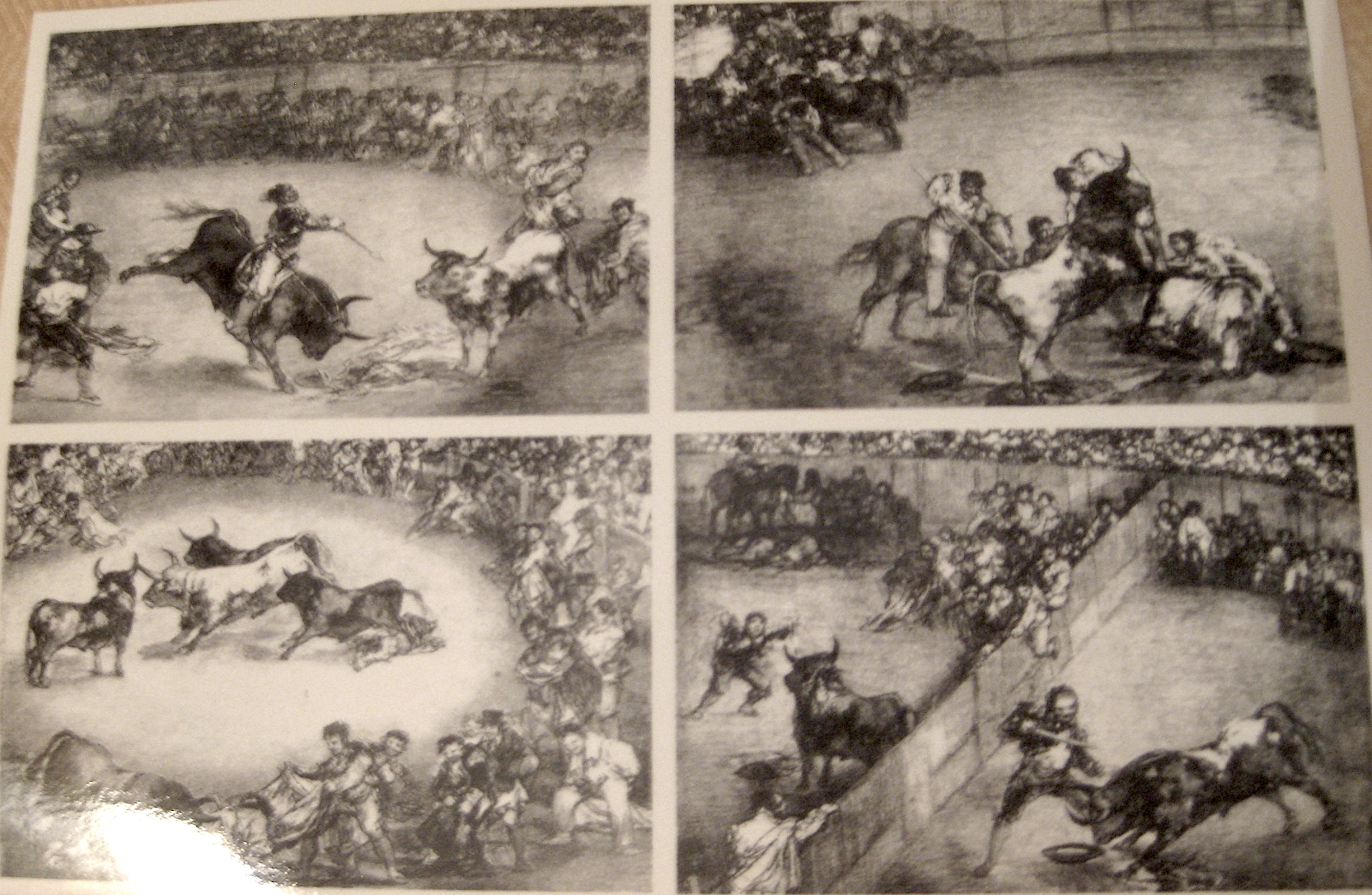
The fine arts section displays items from the 13th century, the Sertorius old school to the more recent, Ramón Acín Aquilué (first time I have viewed his works but I quite like them). For me, the highlights were visiting 2 rooms that are bare and in their original forms (one can see how the stones laid on the floor) and viewing Goya's oil paintings and lithographs from his "Bulls of Bordeaux" series.

On the way back to the hotel, I had the chance to look at the façade of Huesca Cathedral more closely (I always find it amazing to see sculptures on old buildings. How did they do it back then?): 

And the street art too:

Overall, it was a great move to go to Huesca, wasn't it?

On track - Escalona

The next morning, I was on my way to Escalona. I reached Aínsa at noon and decided not to wait 8 hours for the bus to Escalona. I walked into the city centre of Aínsa, and by another stroke of luck, found the only English speaking taxi driver in the town, Jon. (He is from Gilbaltrar, a British overseas territory. He fell in love with Aínsa and moved there.) I took his taxi to Escalona, in time before my next benefactor closed his shop for siesta.   

After 1.5 days of travelling, I finally reached Escalona. To summarise:
22 May 2012
0700 - 0845h - Bus (Sarfa) - Cadaqués to Girona
0932 - 1109h - Train - Girona to Barcelona Sants
1430 - 1755h - Bus (Alosa) - Barcelona Sants to Huesca (there is an earlier option on train but I will not have much time for lunch)

23 May 2012
0945 - 1040h - Bus (Alosa) - Huesca to Sabiñánigo
1100h - 1250h - Bus (Alosa) - Sabiñánigo to Aínsa
1300 - 1315 - Taxi - Aínsa to Escalona

This sure felt like The Amazing Race. With the help of some new friends, the IMPOSSIBLES will soon become POSSIBLES for me.