As we walked in the jungle or cruised by the river, Christian and Jhonatan would whistle or make animal calls, as if reassuring the wildlife that we were friendly parties. Mostly the targets would stop in the track, return their calls and observe us from a distance before continuing their way. It gained us precious moments while I whispered "where?" and searched for the wildlife.
Flora
 |
| 45m above ground and more to climb |
Look at these interesting finds:
 |
| The huge leaf that is bigger than my foot |
 |
| The iodine tree bark produces sap which can be applied to mosquito bites for relief |
 |
| One can knock on the roots of the Ficus (Telephone) tree to ask for help. It produces sound that travel as far as 1 km. |
 |
| A lobster grasshopper on the trunk of a porcupine palm |
 |
| The roots of the stranguler fig tree are taller than a human |
Primates
In the safaris in Africa, nobody would be too concerned with the
monkeys as the predators are more interesting. In the Amazon jungle
however, I found myself wanting to see the monkeys. Afterall, the one I was visiting is
thought to boast the highest number of primate species in an unprotected
reserve.
I saw the pigmy marmoset, owl monkey, tamarin, capuchin
(thought to be the most intelligent of all monkeys), squirrel monkey, spider
monkey and even the Saki monkey (which was thought to be a newly discovered
species). Most of my photographs of the monkeys were not good -
they were either moving too fast and/or on the canopy. In any case, my
old point and shoot camera could only do so much with distance, movement and
low light so I really did not bother to take a lot of photographs.
 |
| Christian pausing to observe and listen |
When we go trekking, Christian would pause to listen for the
monkeys' movements on the canopy, called out to them and tracked them down. We
were supposed to follow him quietly but quickly. Given the way we clumsily
stepped on and broke branches, rustled the dead leaves, tripped over new shoots,
vaulted over fallen trunks and ducked overhanging roots, it really did not help
the "sneak up on the monkeys" cause (seriously?). The monkeys would have heard us from miles away.
 |
| Limbo rock in the jungle |
The Pygmy Marmoset is the smallest monkey in
world, with a body length of only 5 inches. They live in very small groups and
near our lodge too. The breeding female gives birth to twins twice a year .
 |
| Pigmy marmoset |
The squirrel monkey, however, lives in very large groups of 100 - 500. They were like acrobats and I enjoyed watching them jump from tree to tree and from great height too.
 |
| Squirrel monkey |
Reptilias
We saw a number of snakes slid away from us. The coolest would have the Amazon scarlet snake, which swam across the river, slithered up the muddy bank and disappeared into the jungle. The snake lives near water and preys on lizards and small rodents.
 |
| Amazon scarlet snake |
Christian spotted this olive whipsnake, probably an adult, on our first trek. The olive whipsnake is semi-arboreal and is terrestrially active during the day, sleeping in a loose coil on thin branches at night.
 |
| Olive whipsnake |
The caimans we saw were submerged in water. Even Pepe, the resident black caiman at our lodge, was camera shy. Adult black caimans are 8 - 10 feet long, making them the longest Amazonian crocodilians. They are aggressively defensive and should be considered potentially dangerous. I found out the males are really loud during my camping trip. Christian had called out to them (it sounded like a sea lion) and they answered in loud and deep-toned bellows (indicating adult males). It was too bad they were too lazy to charge at us that day and we had no boats to track them down.
 |
| Pepe the black caiman |
The spectacled caiman has a curved bony ridge that crosses the snout to the eyes (hence its name). The adults are 5 - 7 feet long. This species of caiman turns darker during the day, when cold or frightened.
 |
| Spectacled caiman in swamp |
Amphibias
The frogs and toads I saw were mostly tiny, not much bigger than my fingernails. The Amazonian poison frog is a celebrity in the area, with tourists making special trips to find them. The poison is on its skin and the brilliant colours serve as warning to potential predators. I was initially worried about the poison but was reassured that these ones do not have strong enough to harm me. However, I was not allowed to touch it, in case I transfer the insect repellant on my fingers to its skin.
  |
| Amazonian poison frog |
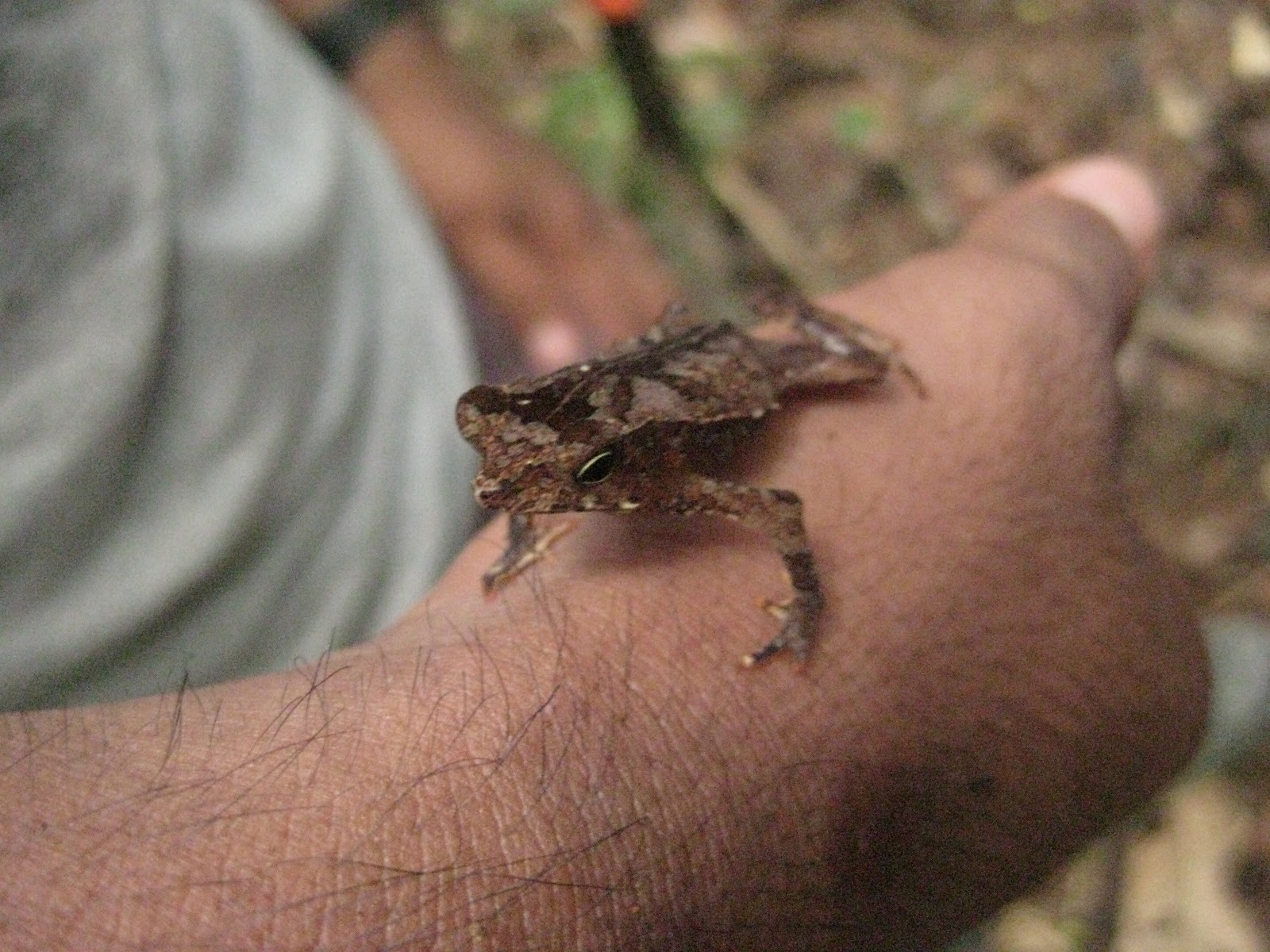 |
| Eyelashed forest toad |

 |
| Tan-legged rain frog |
This treefrog has a 'clown' phase and a 'giraffe' phase, when its skin has spots similar to giraffes'. During reproduction, 300 - 600 eggs are laid on overwater vegetation and the tadpoles drop into the water when hatched.
 |
| Clown treefrog |
Aves
The Amazon is home to one third of all bird species in the world and also serves as sanctuary to migratory birds. I saw a woodpecker, woodcreepers, antbirds, the resident yellow rumped caciques (which live on trees in the compound of our lodge), wattled jacanas and black-collared hawks, just to name a few.
This is the osprey I spotted from a distance (I am so proud of myself!). The osprey is a migrant, often seen singly and have no breeding records for Peru. They prey only on fish.
This is the osprey I spotted from a distance (I am so proud of myself!). The osprey is a migrant, often seen singly and have no breeding records for Peru. They prey only on fish.
  |
| The osprey that I spotted |
The hoatzin are normally perched low over still or slow-moving water. The most amazing thing about this bird is that it has links to some fossils from 5 - 23 million years ago (Miocene period). It looks like a pheasant but is linked to the cuckoos.
 |
| Hoatzin Photo credit: Christian |
 |
| Turkey vulture in flight |
 |
| I spy blue-and-yellow macaws |
 |
| Blue-and-yellow macaw |
 |
| Found during one of our night boating trips Ringed kingfisher sleeping on a skinny branch above the river Isn't it worried it would nod off and fall into the water? |
 Others

We did not "only" see birds and monkeys. On my camping trip, Christian, Manuel and I had been trekking for 2 hours to look for caimans when Christian spotted a three-toed sloth behind a tree next to our trek. Before this, I only knew Sid the Sloth from Ice Age (he is nothing like this beautiful babe) and the 'closest' real thing was seen from a boat - a male with an orange belly on a 40m high tree top in a distance. We were really lucky. Apparently, sloths eat, sleep, give birth and die holding on to branches on tree tops. They only come to the ground once a week to urinate and defecate, digging a hole and covering it after. I hope we have not interrupted her toilet break!
 |
| Three-toed sloth |
Video: The fast sloth
Sources:
My guides, Christian and Jhonatan
Reptiles and amphibians of the Amazon by R.D. Bartlett and Patricia Bartlett
Birds of Peru by Thomas S. Schulenberg, Douglas F. Stotz, Daniel F. Lane, John P. O'Neill and Theodore A. Parker III


